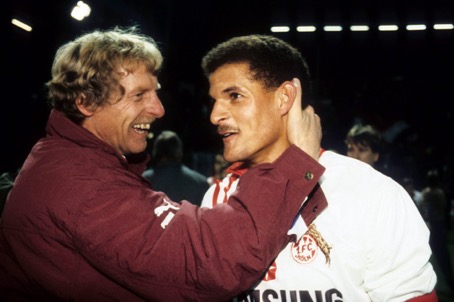
Special Moments
Sunday, November 17, 1991. At the 1. FC Köln training ground, coach Jörg Berger asks his players to do only a light jog after the 0-3 thrashing at FC Schalke 04. The idea is to clear their heads somehow. It doesn't work. A police officer appears unannounced. His question — whether the player Maurice Banach (24) had turned up for training today — Berger has to answer in the negative. "He has probably been killed in an accident," the officer tells the stunned coach. According to police, Banach died in the early hours after his car left the road.
Maurice Banach — his death shook not just Cologne but all of German football. That Köln could not play their next match against Dynamo Dresden and had to cancel was a given in those bleak autumn days of 1991. At the Belgium–Germany international (0-1) a few days later, a minute's silence was observed for Banach. German football had lost one of its brightest hopes — a player on the verge of international call-up, whom all observers credited with a glittering future.
And a goal machine. Signed from 2. Bundesliga promoted side SG Wattenscheid 09 in the summer of 1990, "Mucki" — as they had called the 1.88-metre striker since his days in Münster — made an immediate impact in Cologne. "Our great hope," Jörg Berger later recalled, "wasn't Pierre Littbarski or Horst Heldt — it was Mucki Banach." The man who had fired Wattenscheid into the Bundesliga with 22 goals and won the 2. Liga golden boot was back in Germany's elite.
Before his fatal accident, which was never fully explained, Banach scored ten goals in 18 league appearances in the marathon 1991/92 season. Many 1. FC Köln observers still believe that with Maurice Banach, a permanent place in the top five — perhaps even a third German championship after 1964 and 1978 — would have been within reach. His death put a sudden end to those hopes. In 1989 and 1990, Köln had narrowly missed the title as runners-up. So it remained a dream.
That the two goals in the 4-1 win against Fortuna Düsseldorf on November 9, 1991 would be the last of Maurice Banach's life, nobody in Müngersdorf knew at the time. A week later, Banach stayed in his hometown Münster after the away match at Schalke 04 — a stay that would later fuel speculation. Reports that he had been driving drunk after attending a carnival event turned out to be false. Nevertheless, the circumstances of the crash were never fully clarified.
It is precisely these details that have contributed to Banach becoming a myth in Cologne — an eternal fan favourite. More than 25 years after his death, Maurice Banach — who as the son of an African-American US soldier and a German mother surely never had it easy in deeply Catholic Münster — remains unforgotten in the Cathedral City. Videos of his most spectacular goals still circulate regularly in FC forums, and posters commemorated the player who died far too young on the 25th anniversary of his death.
While life in the Bundesliga went on, the FC did not play again until 14 days after the tragedy. Candles in the FC fan section and countless banners reading "Only those who are forgotten are truly dead. We will NEVER forget you, Mucki" filled the Müngersdorf stadium. At the dutiful 1-0 win over VfL Bochum, any goal celebration was out of the question. Cologne stood together — "Echte Fründe stonn zesamme" — the famous line from the De Höhner song was more than just lip service that day.